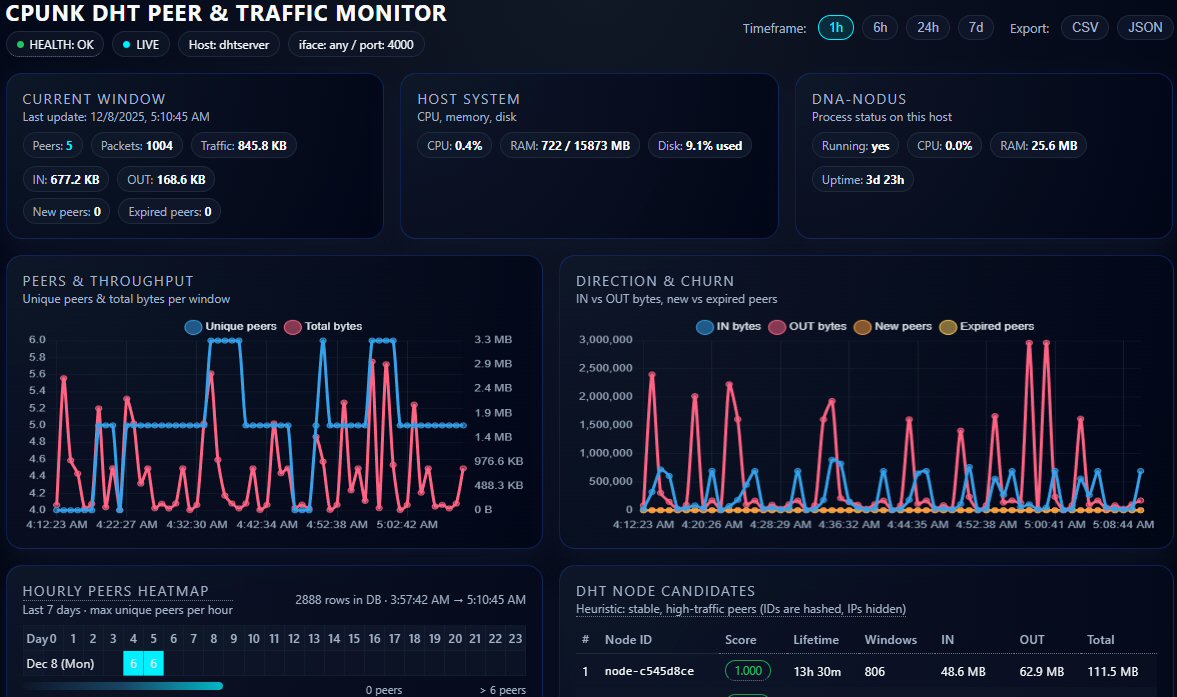
What are DHT & Bootstrap Nodes in CPUNK?
In the CPUNK protocol, DHT & bootstrap nodes form a
distributed index and rendezvous layer for
DNA-Messenger and DNA identity. Instead of depending on a single
central server, peers use the distributed hash table to:
- Discover other peers and their current reachable endpoints
- Locate outgoing message mailboxes stored in the network
- Resolve DNA identities to public keys and routing hints
Bootstrap nodes act as entry points to this
DHT network. A new client only needs a small list of bootstrap
nodes to join the distributed overlay and start participating.
How they support DNA-Messenger
DNA-Messenger is designed so that messages do not depend
on any single server. When one user sends a message to another:
-
The message is encrypted end-to-end (e.g. using Kyber/Dilithium +
symmetric ciphers).
-
The ciphertext is written into the sender’s outgoing mailbox
in the DHT layer.
-
That mailbox is replicated across a small set of
nearest bootstrap/DHT nodes, typically the 8 closest.
-
When the recipient comes online, their client queries the DHT,
locates relevant mailboxes, and pulls messages directly.
This makes it possible for messages to be delivered even when
the sender has already gone offline, without introducing a
centralized message store.
Operating a Bootstrap Node
Running a bootstrap node is primarily about providing
reliable uptime and bandwidth for the network.
The software will be packaged so that operators can:
- Deploy on Linux (bare metal or VPS)
- Use systemd service files for long-running daemons
- Expose only the required ports for P2P discovery
- Monitor resource usage and peer connectivity
The node does not need to see message contents. It stores and
forwards encrypted blobs and key-value metadata used for routing
and identity resolution.
High-level requirements
- Stable network connection with public reachability
- Consistent disk availability for DHT storage
- Basic Linux administration familiarity